
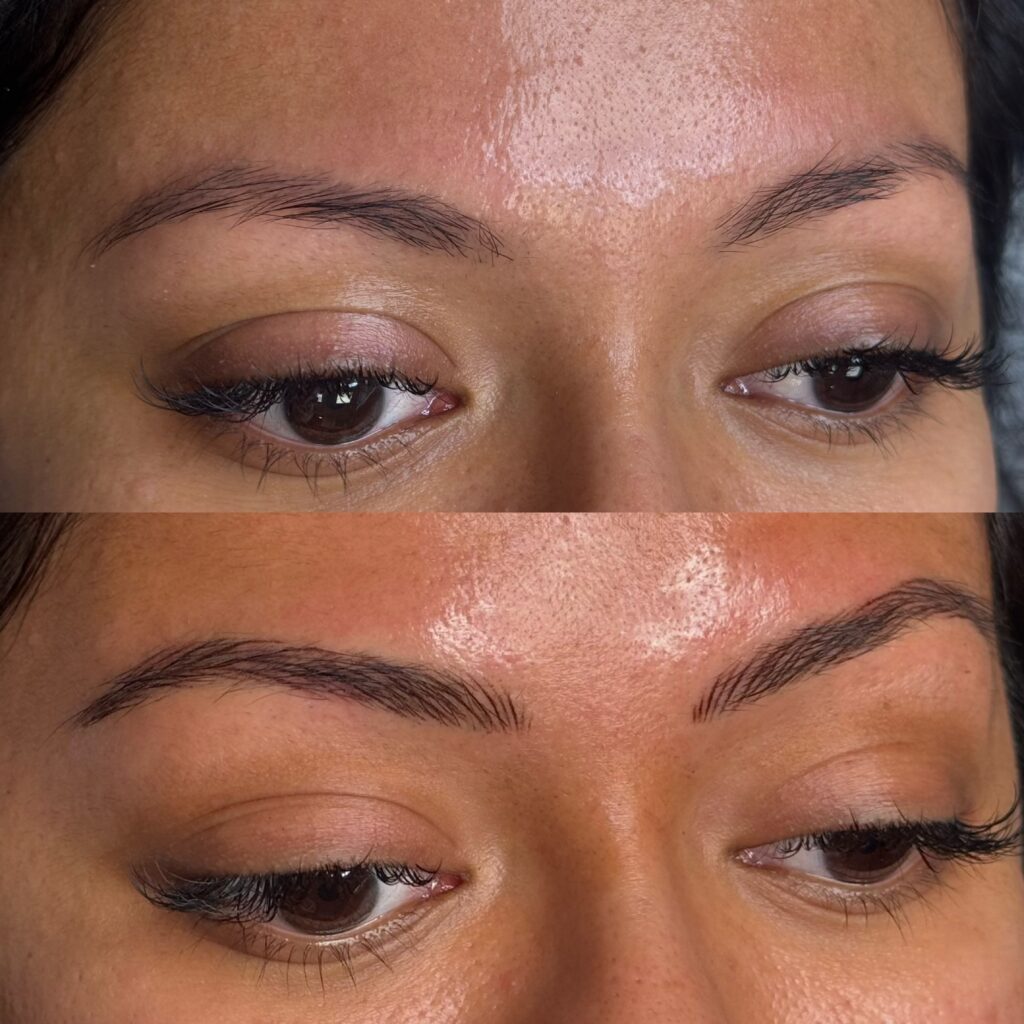
Before any permanent brow treatment begins, a skilled artist performs brow mapping — a precise measurement process that determines where your brows should start, arch, and end based on your unique facial structure. It’s one of the most important steps in getting results that look natural and balanced.
What Is Brow Mapping?
Brow mapping is the process of using precise measurements and reference points on your face to determine the ideal placement for your eyebrows. It’s done before any permanent makeup treatment — powder brows, nano brows, combo brows — using tools like a flexible ruler, a mapping string, or a pre-inked thread to mark key points on the skin.
The goal is to design a brow shape that is symmetrical, proportional to your face, and flattering to your bone structure — before any pigment touches your skin.
The Three Key Points of Brow Mapping
1. The start of the brow
A line drawn vertically from the outer edge of the nostril, straight up past the inner corner of the eye, indicates where the brow should begin. Brows that start too close together can make the face appear heavy between the eyes; brows that start too far apart can look disconnected from the face.
2. The arch
A line drawn from the outer edge of the nostril, angled through the centre of the iris (looking straight ahead), points to where the natural arch of the brow should peak. A too-forward arch can look surprised or unnatural; a too-far-back arch can flatten the face.
3. The tail
A line from the outer edge of the nostril, angled through the outer corner of the eye, indicates where the brow should end. The tail should generally end at or slightly above the starting height of the brow — ending significantly lower can create a downward expression that’s difficult to correct with makeup.
Why Brow Mapping Matters for Permanent Makeup
When brows are drawn on with pencil or powder each morning, a mistake can be wiped away and redrawn. Permanent brows cannot be corrected the same way — so getting placement right before the pigment goes in is essential.
Brow mapping ensures:
- Symmetry — both brows follow the same measurements, accounting for natural facial asymmetry
- Proportion — the brow shape suits your face shape and feature spacing
- Client approval before commitment — the mapped shape is shown to you and adjusted before any work begins
- Predictable results — the artist works to a plan rather than freehand
Facial Symmetry and Brow Mapping
Most faces are naturally asymmetrical — one eye may sit slightly higher, one side of the nose may be wider. A skilled brow artist accounts for this during mapping. The goal isn’t to make the brows identical — it’s to make them appear balanced when looking at a person naturally. This is why brow mapping requires skill and experience, not just measurements.
What Happens During Brow Mapping at Your Appointment
Step 1 — Consultation: Your artist asks about your brow goals and reviews your brow history. Bring reference photos — they help communicate the shape and density you’re aiming for.
Step 2 — Mapping: Using a string or ruler, your artist marks the three key reference points and traces the proposed brow outline on your skin with a pencil or marking tool.
Step 3 — Review and adjustment: You look in the mirror and give feedback. Adjustments are made until you’re happy with the shape, placement, and thickness. No pigment is applied until you’ve approved the mapped shape.
Step 4 — Treatment begins: Once you’ve approved the mapped shape, your artist proceeds with the brow treatment.
What to Consider When Choosing a Brow Shape
- Thickness: Thicker brows look more contemporary; thinner brows are more delicate.
- Arch height: A softer arch looks more natural and youthful; a higher arch is more defined.
- Tail length: Longer tails can elongate the face.
- Natural growth pattern: Working with your natural brow hair usually gives the most natural result.
What Happens If Brow Mapping Isn’t Done?
When brow mapping is skipped or done carelessly, the results can be brows that are uneven, disproportionate, or start and end in the wrong place for your face. Corrections for incorrectly placed permanent brows may involve laser removal or colour correction — both of which require multiple sessions and significant added cost.
For more on what to look for in a permanent makeup artist, see our post on what to look for in a permanent makeup studio in Mississauga.
Frequently Asked Questions
Is brow mapping painful?
Not at all. Brow mapping is just measurement and marking — nothing is inserted into the skin. It’s done before any numbing cream is applied.
Can I request a specific brow shape?
Yes. Brow mapping is a collaborative process. Your artist will use measurements as a guide and then adjust based on your preferences. No pigment is applied until you’re satisfied with the shape.
Does brow mapping work if I have very sparse brows?
Yes — brow mapping is especially useful when natural brow hair is sparse, because there are fewer visual cues to rely on. Measurements provide the objective reference points the design needs.
If you’re considering powder brows, nano brows, or any permanent eyebrow treatment in Mississauga, book a consultation at Victoria Studio. Every appointment starts with thorough brow mapping before any treatment begins.
Also see: How I Customize Brow Shape for Your Unique Facial Structure
Victoria is a certified permanent makeup artist and educator in Mississauga, with expertise in brow design and semi-permanent eyebrow techniques.